


LED Chips
Binning
A tight binning process reflects the quality of each individual LED chip.
During industrial LED chip production, minor variations occur even within the same batch, resulting in small differences between individual chips.
Color temperature (Kelvin), color, luminous flux (lumens), and the required forward voltage can vary within a production run. As a result, LED chips installed in a single fixture may show slight differences. This classification process is known as binning. The chips are sorted into different bins according to how narrow or wide the specified quality parameters are. The larger the bin—or the wider the sorting tolerance—the greater the deviations between the chips. The tighter the binning, the more complex the sorting process becomes, ultimately increasing cost but also improving product quality.
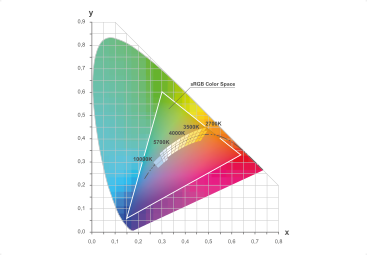
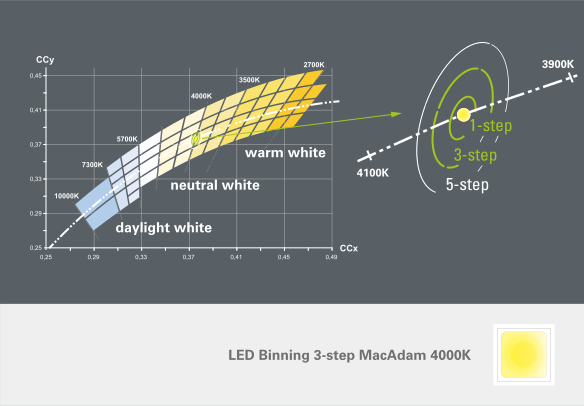
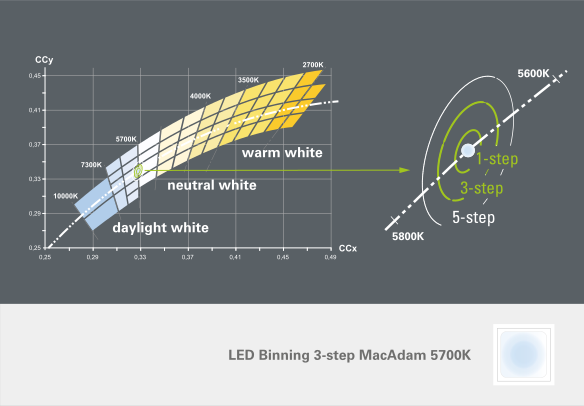
- Binning of LED2WORK LEDs
To ensure a consistent light profile, the LED chips we use are sorted within tight tolerances according to their characteristics. This guarantees reproducible lumen output, color temperature, and color rendering—within a single production batch and, of course, across future batches as well.
Energy efficiency
LED technology inherently provides energy-efficient lighting.
All LED2WORK luminaires offer high energy efficiency. Traditional lighting concepts from past decades perform significantly below today’s achievable levels. For example, incandescent bulbs deliver up to 12 lm/W, fluorescent lamps up to 100 lm/W. The LED chips we use today reach up to 180 lm/W (laboratory value, junction temperature 25 °C (77 °F) Tj).
LED2WORK luminaires are generally specified using their real lumen values (junction temperature approx. 85 °C (185 °F) Tj).
Color Rendering Index Rₐ
The higher the color rendering index, the more accurate the color reproduction.
The Color Rendering Index (CRI) is specified as an Rₐ value and indicates how faithfully a light source reproduces colors. It describes how the color rendering of an artificial light source compares to sunlight. The higher the Rₐ value, the better the color accuracy of the light source. The CRI can reach values up to 100, which corresponds to perfectly natural color rendering (sunlight, blackbody radiation).
| Colour Rendering Index Ra | Quality |
| Ra 100–90 | excellent |
| Ra 90–80 | good |
| Ra 80–70 | satisfactory |
| Ra 70–60 | sufficient |
| Ra 60–50 | poor |
| Ra 50–0 | very poor |
| Light Source | Index Ra |
| Sunlight | 100 |
| Incandescent lamp | up to 100 |
| White LED | 75…98 |
| OLED | 80…90 |
| Fluorescent lamp | 50…90 |
| Energy-saving lamp | 90…90 |
White LED
From a physical standpoint, LED chips do not emit white light directly. To generate white light, a blue-emitting LED chip is used, and its light passes through a phosphor layer. This phosphor layer adds the missing spectral components to the blue light, resulting in white light.
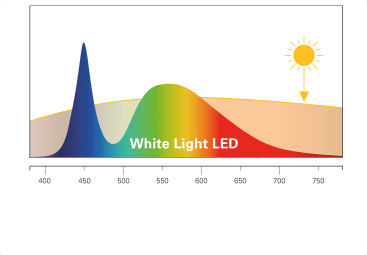
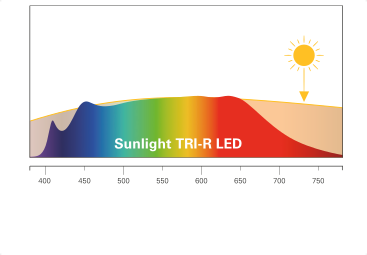
LED chips with TRI-R technology
LED chips using TRI-R technology rely on a semiconductor chip that emits violet light. Through photoluminescence, this light is fully converted into red, green, and blue components. As a result, no unconverted semiconductor light remains in the spectrum, and the LED output shows no spectral gaps. The light produced by TRI-R LEDs contains the full color spectrum comparable to sunlight and delivers excellent color rendering and high color quality.
Spectral distribution of LEDs with TRI-R technology.
Light spectrum
All LED chips used by LED2WORK operate within a wavelength range of 400–800 nm.