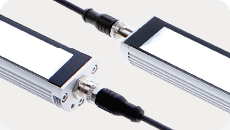
Light
Colour Temperature
The colour temperature, also known as correlated colour temperature, is measured in Kelvin. The higher the Kelvin value, the cooler the light appears. In trade and industrial environments, luminaires typically feature colour temperatures between 3,000 K and 6,500 K, depending on the application and requirements.

Total Luminous Flux = Lumen [lm]
Lumen, symbol lm, is the unit of the total luminous flux of a luminaire or the LED module used. Total luminous flux represents the overall amount of light emitted in all directions.
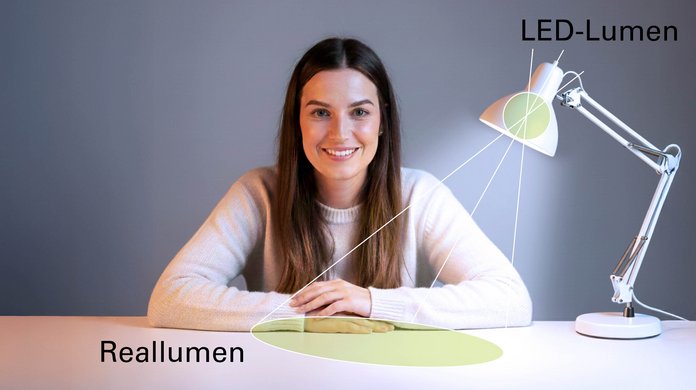
Real Lumens
Real lumens refer to the actual measured brightness of the complete luminaire.
Lumen is the basic unit of luminous flux. Manufacturers of incandescent lamps, fluorescent tubes, or LED chips typically specify the total luminous flux of the light source in their technical data sheets. This clearly defines the luminous flux (lumens) that can be expected.
Due to laboratory measurement procedures used by light-source manufacturers, the lumen values stated in data sheets are not fully achieved in real-world operation. Additionally, every material in the path of the emitted light (diffusers, covers, glass panes) further reduces the light output.
Real lumens represent the actually measured lumens emitted from the luminaire. This is not a theoretically calculated or scaled value based on data-sheet lumens of LED chips, but a measured and certified figure.
Illuminance = Lux [lux]
Lux, symbol lx or lux, is the unit of illuminance of a luminaire or the LED module used. Illuminance describes the amount of light falling on an area of 0.5 m² or 1 m² from a light source.
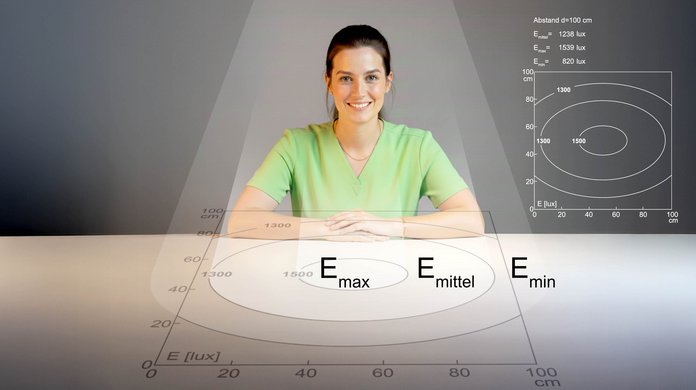
Isolux Diagram
An isolux diagram illustrates the light distribution of a luminaire on a defined surface, typically 100 cm × 100 cm with a mounting distance of 100 cm. The values indicated at Emax represent the maximum achievable lux level at the center of the surface. The value Emin indicates the minimum level on the surface, and Emittel represents the average of all measured values across the surface.