


Service life and thermal management
Service life of LED luminaires
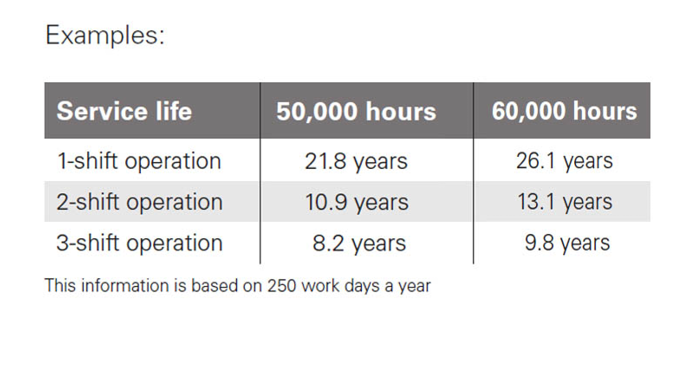
Our LED luminaires are developed as durable products. The service life of the luminaire and the installed electronics is at least 50,000 operating hours (high-power LED technology) or at least 60,000 operating hours (mid-power LED technology). As soon as the luminous intensity drops below 80 %, the service life of the LED is considered fulfilled. However, this does not mean that the luminaire fails immediately, but a further reduction in luminous flux below 80 % of the original value can be expected.
The LED chips themselves are also much less sensitive to vibrations than conventional light sources. As a rule, the LED luminaires outlive the plant in which they are installed.
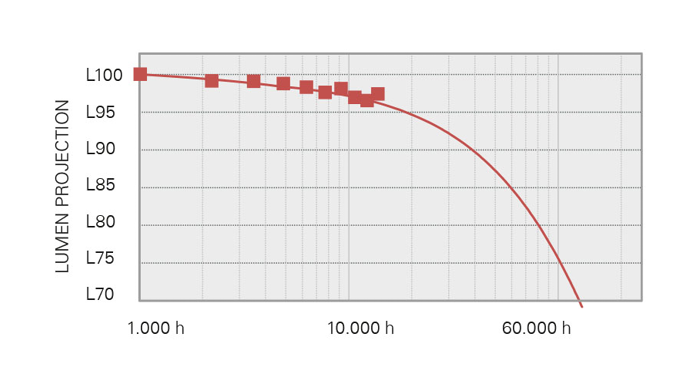
- L80: The L-value of a luminaire indicates the percentage of the total luminous flux of an individual LED module remaining at the end of its service life (LED2WORK usually 60,000 h).
The reason for this is that a light source slowly degenerates over its lifetime and emits a little less light. In the case of LED2WORK, this maximum reduction corresponds to the 20% mentioned above after 60,000h.
- B10: The B value indicates that 10 % of the LED modules used can exceed the drop in total luminous flux specified by the L value, but maintain at least 90 % of it or even fall below that.
External Factors Affecting Service Life
Compared with conventional light sources, a complete failure of LED chips is extremely rare. Once integrated into a fixture, they are virtually maintenance-free. Only the luminous output decreases slightly over the operating period. Both internal and external factors influence the service life of the LED.
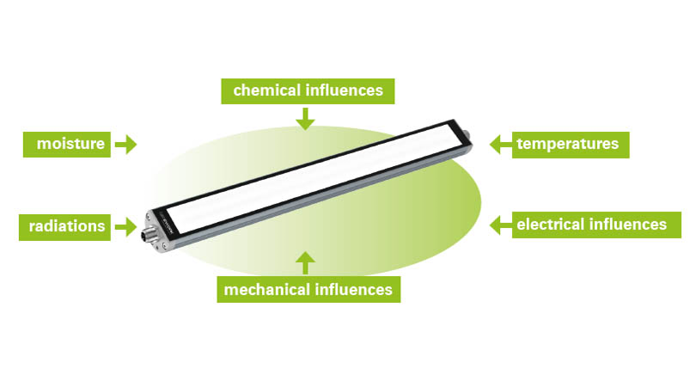
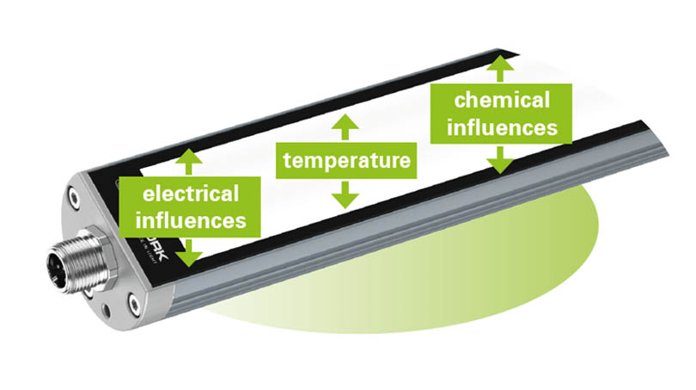
A high-quality housing made of specially alloyed aluminium also acts as a heat sink for the built-in electronics and therefore ensures optimum thermal management of the LED chips. At LED2WORK, we work with aluminium core circuit boards for fast heat dissipation on the housing. With the right thermal management, we succeed in maximising the service life of the LED chips used.